Skip to content

head over heels

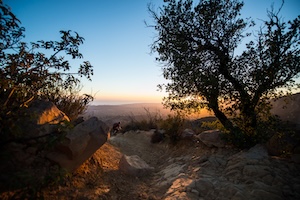
rocky single track in the sunset

A few years ago now, I wrote a column called Chain of Fools for Mountain Flyer Magazine. In this edition, the fool meets some new friends and makes the best possible first impression. This story ran in Mountain Flyer, Issue 76.

We meet at the trailhead early, but not too early. Waiting for the stragglers to arrive, there’s a lot of looking at bikes and talking about tires and toying with suspension. I’m the new girl. I try not to be nervous. I don’t know this crew yet, but I do know they ride mountain bikes just like I do. Bikes. It’s just bikes.

The ride begins with a climb. Is it better to climb first or climb home? Eat your vegetables, then you can have dessert: That’s what my mom always says. My inner whiner wants dessert both now and later. There is no too much when it comes to the good things in life like long descents and frosted donuts.

We string out on the climb and happy not to be last, I settle somewhere in the middle. The dirt changes with the elevation as the soil’s minerals stain each layer a different hue. Eventually, I will come to learn the sequence so well that I can count down each climb. But that’s for the future. Today it’s all new to me. The climb ends sooner than I expect, which boosts my confidence.

At first, I don’t see it. The descent drops abruptly off the edge of the fire road and makes a hard right turn. The fall line looks more fall than line. The first corner’s off-camber and littered with dry California dust. Manzanita bushes and assorted spiky plants surround the trail. A few loose rocks pitch in to keep it interesting. Looks fun, I tell myself.

Read more
postcard

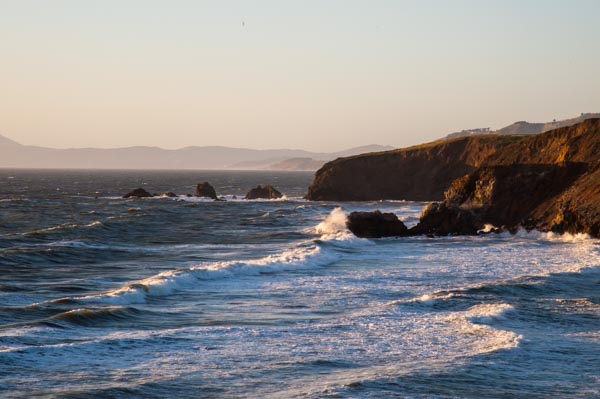
Rocky beach with surf at sunset in Pacifica, California

I wrote this short essay for Wildsam Magazine to serve as an introduction to a feature on roadtripping through California’s surf towns. I have spent some time in such places, as you all know. They are a whole vibe, though each has its own flavor.

Exit West. Gas. Food. Lodging. An archipelago of towns runs the length of the California coast, connected by a tangle of freeways and yet, existing a world apart from them. Start in San Diego and follow the Pacific Coast Highway north. White sand and easy turns wild and rugged. Palm trees give way to cypress, pines, and redwoods. Each town has its own personality, but all along the way, the ocean is ever-present in all its shifting moods. Life dances to the rhythm of the tides.

In the early 20th century, Duke Kahanamoku brought surfing to California, but it remained for films like the 1959 classic Gidget to rocket surfing into the mainstream. Once there, it never left. Board maker Hobie Alter opened California’s first surf shop in Dana Point in 1954, and before long, just about every town on the coast had its own shop and local board label. With their boards tucked under their arms, Californians headed to the beach and a whole way of life evolved around their newfound obsession.

When the waves turn on, the rhythm changes. Before sunrise, the line runs around the block at the coffee shop and blocks the sidewalk outside the tacqueria that’s serving up breakfast burritos. Traffic crawls along the PCH. Heads hang out car windows, staring at the waves and searching for that elusive parking spot. Boards slide out of cars, wetsuits tug into place. Hurry, gotta get out there. Swell lines stretch to the horizon, and surfers jostle for the best waves like a pack of hungry seagulls on a bag of chips.

All too soon, the wind comes up and the tide drains out. Sandy toes slide hastily into shoes and socks, and head off to the day job. Whatever it takes to stay right here and live this life.
When the sun sinks toward the horizon and transforms the salt spray to golden haze, it all feels like a dream.

And maybe it is.

Profile: Matt Warshaw

Surf historian Matt Warshaw spends his days in Seattle sifting through the ruins of our strange and beautiful past time. He says he’s motivated by an effort to assign meaning to his own story and to understand why he’s spent so many hours of life obsessed with riding waves. How did he arrive here? Matt learned to surf in Venice Beach with Jay Adams, competed in the first Katin Pro/Am, edited Surfer Magazine — and that was just the beginning.

In 2022, I wrote a profile of Matt for the print magazine Emocean. The story appeared in the magazine’s fourth issue, Devotion. It was a joy to work with the crew at Emocean, who love surfing and making print media as much as anyone I’ve ever met. You can check out their current issues available at emocean.surf. Here’s the story of Matt’s life-long fascination with surfing.

When Matt Warshaw was six years old, there were three things he wanted to be: the driver of a drag racing car, a drummer in a band, and a surfer. One day his Uncle Daniel came to visit and brought his Hansen longboard. At the time, Warshaw and his family lived in the San Fernando Valley and they had a backyard pool. Uncle Daniel put his board in the pool and told Warshaw to sit on it. Then he pushed it across the pool. On the third trip across the pool, Uncle Daniel told Warshaw to stand up. “In my mind, I was a surfer.”

Read more

last dance

In December 2019, I made one last trip not long before Covid 19 shut down everything. Deep in the trees in the Pacific Northwest, I went to the U.S. cyclocross national championship for VeloNews, a publication that has since disappeared like so many others. It was then, a last dance for all kinds of reasons. Here’s a short story about what I saw out in that muddy field not far from Seattle.

There’s a man pedaling an ancient stationary bike and banging a cymbal with a single drumstick. Somehow, this feels completely normal. So does the unicorn piñata, the light strings hanging from the trees, and the inflatable snowman. A snow machine spits flurries. Also, there’s a bike race.

This is U.S. cyclocross racing, with its near-surreal mix of leg-breaking intensity and track-side shenanigans. My friend and I try to make sense of it. It’s what you do if road racing is too Type A, he says.

But any sport that has room for bacon and dollar hand-ups can’t be all that Type A at all. There’s space for everyone here and a giddy sort of joy. Come as you are. Make it what you want it to be.

If I’d raced bikes in a place like Seattle, Portland, or New England, this might have been my world. Road never suited me, enduro didn’t exist yet. I raced mountain bikes, but looked curiously at this sport that requires to carrying a bike on your back.

Who even does that? Lots of people, as it turns out. A good cyclocross racer is an alchemist at play. Fearless speed, bottomless aerobic capacity, acrobatic bike and running skills: It all seems like some kind of magic.

Read more

the map

He drew me a map, the paper torn from my notebook. We stood over the hood of his white truck, a diesel converted by hand to run on vegetable oil.

We were stopped by the side of a road running through the cow pastures. The grass gleamed green from the winter’s rains. Only the wind interrupted the silence. The fence lines marched straight until they disappeared over the crest of the hill.

There’s a climb here, he said. Then you descend a short ways and turn left. His pen traced out the switchbacks of the twisting descent and the sharp bend of the turn. In small tidy print, he spelled out the names of the roads. After the schoolhouse, you turn right. 

We had driven the length of the bay. The San Andreas fault runs down the middle and pushes it wider all the time. The west side is moving, slowly inexorably, north.

As we drove he pointed out the landmarks. Here was the boatyard owned by his neighbor. Next came the oyster fisherman. There was the farmhouse dating back five generations.

The wind funnels through the narrow bay pushing up whitecaps and propelling kitesurfers. It’s no place for the faint of heart. Sharks breed in the protected water. He told me a story about bumping into a giant white in a very small boat. They only come in one size, the sharks. They’re only ever giant.

I tucked the map in the front of my bibshorts and followed the fence lines to the first winding climb. The pavement felt heavy, but I had a tailwind. When my phone stopped working, it felt perfectly right. I’d reached the end of the grid, a place where the world was as it always was. I had my precious map, I was off to seek treasure.

Read more

big thursday

I cruise down the beach and pass through a parking lot littered with sand and kelp, the sure signs of a high tide and a big swell. Normally, there aren’t really even waves on this part of the beach. I look out to overhead sets, brown with churned up sand. Even from the beach, I can see how the long period swell is moving water deep beneath the surface. It’s anything but playful.

A pair of guys walk down the beach carrying Wavestorms under their arms. I laugh. Where there’s a wave, there’s a Wavestorm. They look excited and optimistic. The Harvest buoy off Point Conception reads 23.3ft, 18 seconds, 283 degrees. The ocean laughs at your optimism.

“We are all the idiots,” my friend writes in a text. “We just don’t know it until our luck runs out.”

Read More at Beachgrit.